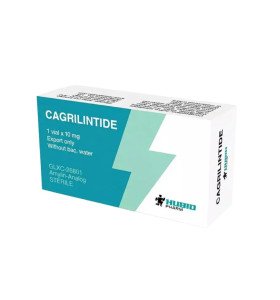


Buy Cagrilintide Peptide Online – Premium Quality for Research & Weight Management
Intro paragraph
Cagrilintide is a long-acting amylin analogue, and it works through a different receptor system from the GLP-1 compounds that dominate this market. Most of the current clinical interest in it comes from CagriSema, the fixed combination of cagrilintide with semaglutide, which has produced the largest weight reductions reported in a phase 3 trial to date. This category covers what cagrilintide is, what the combination data showed, where its approval stands, and what to check before ordering.
What is cagrilintide?
Cagrilintide is a synthetic analogue of human amylin, a hormone co-secreted with insulin by the pancreas. Amylin slows gastric emptying, suppresses glucagon secretion and increases satiety, and the native hormone has a very short half-life. Cagrilintide was engineered to bind to both amylin and calcitonin receptors and to resist breakdown, which is what makes a once-weekly dose possible.
It is important to separate the two things that share this name: cagrilintide is a single molecule, while CagriSema is a combination product containing cagrilintide 2.4 mg plus semaglutide 2.4 mg. Nearly all published human data belongs to the combination, not to cagrilintide alone.
Mechanism, and how it differs
Every other compound in this category on our site targets GLP-1 or the GLP-1/glucagon pair. Cagrilintide does not target GLP-1 at all. Its value in the combination is additive: amylin receptor activity suppresses appetite through a separate pathway, so pairing it with a GLP-1 agonist produces an effect neither achieves alone.
In REDEFINE 1, at week 68, cagrilintide alone produced 11.5% mean weight reduction, semaglutide alone 14.9%, and the combination 20.4%. That is the clearest illustration of why the two are studied together.
Approval status
As of October 2026:
| Item | Status |
|---|---|
| Cagrilintide as a standalone medicine | Not approved anywhere. |
| CagriSema (cagrilintide + semaglutide) | Under review. Novo Nordisk submitted an NDA to the US FDA in December 2025 for weight management, based on the REDEFINE 1 and REDEFINE 2 trials. No approval has been granted at the time of writing. |
| European Union | No approval. |
| China (NMPA) | No approval. |
Being under review is not the same as being approved. Any listing that describes cagrilintide as an approved medicine is inaccurate.
What the trials showed
REDEFINE 1 was a 68-week phase 3 trial in adults with obesity or overweight, published in the New England Journal of Medicine. Two figures circulate for its main result, and the difference is methodological rather than contradictory:
- 22.7% mean weight reduction, for participants who completed treatment
- 20.4% mean weight reduction, in the overall intention-to-treat analysis
- Placebo: 2.3%
Both are correct; they answer slightly different questions. The completers figure describes what happened in people who stayed on treatment, the intention-to-treat figure describes the whole randomised group, including those who stopped. When you see one quoted without the other, that is usually the reason.
REDEFINE 2, in adults with type 2 diabetes, reported a lower mean reduction of around 14.2%, which is consistent with the pattern seen across this drug class in diabetic populations.
Gastrointestinal adverse events were the most commonly reported, in line with the GLP-1 class, and discontinuation rates reflected that. These are trial results in a monitored population, not a prediction for any individual, and not dosing guidance.
What we supply
The cagrilintide we list is a lyophilized (freeze-dried) powder in sealed vials, supplied as research-grade material. It is neither the approved product nor the CagriSema combination; it is cagrilintide alone, and it has no regulatory approval in any market.
Every vial ships with batch documentation, and a certificate of analysis stating identity and purity is available on request. Orders are shipped with temperature control. A lyophilized peptide that has been exposed to heat or repeated temperature cycling is not the product you paid for, and we treat cold-chain handling as part of the product rather than as an optional extra.
Storage and handling
Store sealed vials dry at -20 °C for long-term storage, or at 2 to 8 °C for short periods. Protect from light and moisture and avoid repeated temperature cycling. Once reconstituted for a laboratory protocol, follow that protocol's requirements and keep the solution refrigerated. Keep out of the reach of children.
Frequently asked questions
Is cagrilintide the same as CagriSema? No. Cagrilintide is one molecule. CagriSema is a combination of cagrilintide and semaglutide. The headline phase 3 results belong to the combination.
Is cagrilintide approved? No. Neither cagrilintide alone nor CagriSema is approved as of October 2026. CagriSema is under FDA review following a December 2025 submission.
Is it a GLP-1 agonist? No. It is an amylin and calcitonin receptor agonist. That is precisely why it is combined with a GLP-1 agonist rather than compared to one.
Why do I see both 20.4% and 22.7% for the same trial? 20.4% is the intention-to-treat result; 22.7% is the result among participants who completed treatment. Same trial, two analysis populations.
Do you provide a certificate of analysis? Yes, on request, per batch, stating identity and purity for the batch shipped.
Important information
Cagrilintide as supplied here is a research chemical for laboratory use only. It is not a medicine, it is not approved for human or veterinary use in any jurisdiction, and it is not intended for diagnosis, treatment, cure or prevention of any disease. No dosing or administration information is supplied, and none should be inferred from the trial data summarised on this page. Not for injection, ingestion or any form of human consumption. Buyers are responsible for complying with the law in their own jurisdiction. Handle with standard laboratory precautions and dispose of according to local regulations.